The Best way to experience the beauty of the Wild Coast is to take the 5 day hiking trail run by Jimmy and Mbuyi. Please visit their site for more information, rates and details at www.wildcoasthikes.com.
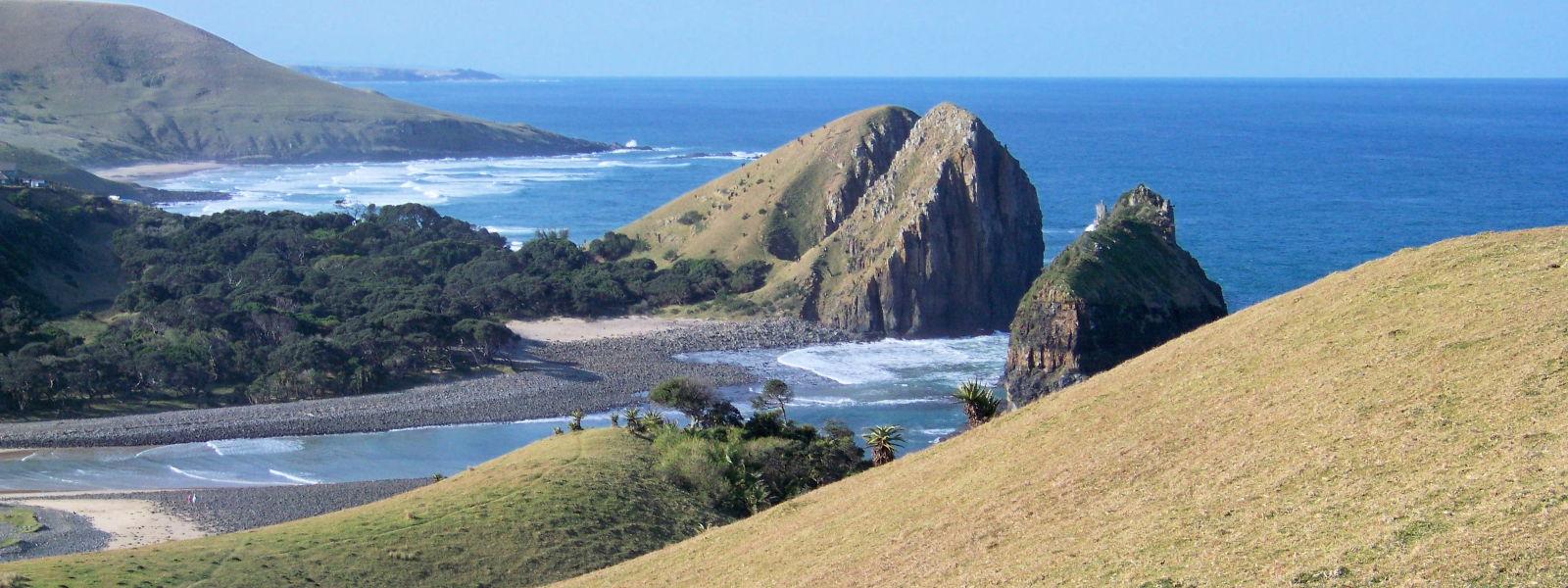
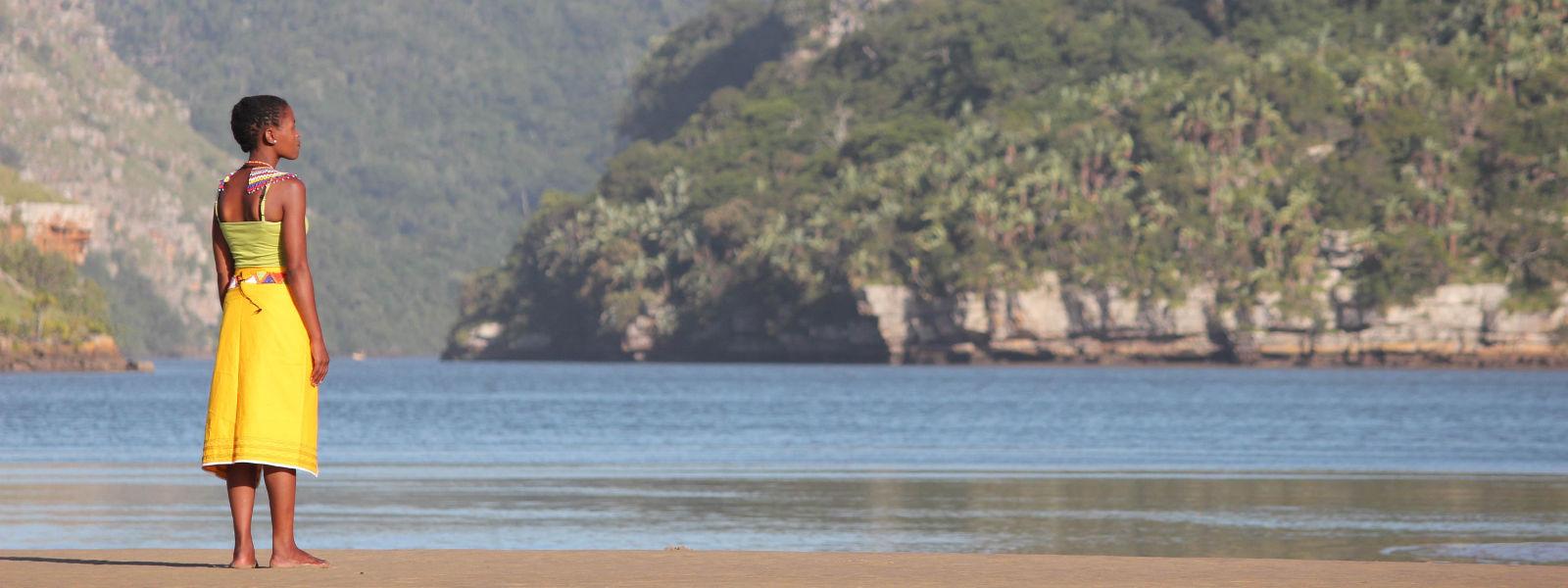
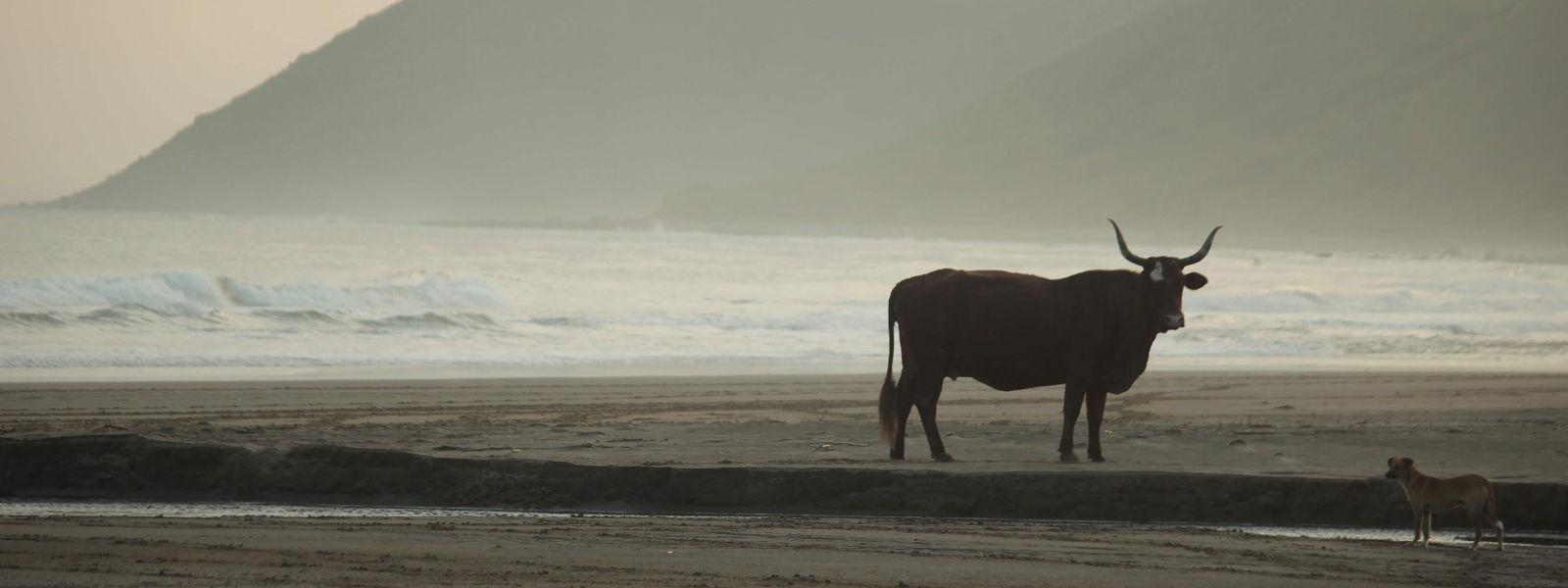
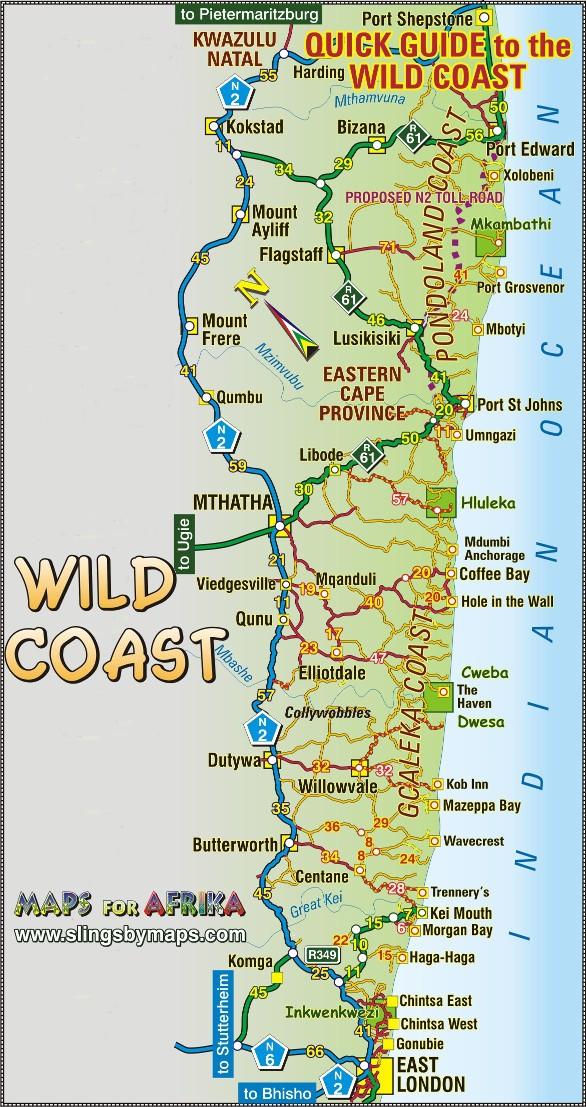
The Port St. Johns to Coffee Bay Hiking Trail goes through some of the most beautiful hiking landscape in South Africa. The trail hugs a stretch of coastline along the former Transkei homeland, and is unspoilt and barely touched by development. You will walk along rolling grassy hills dotted with colourful huts, idyllic beaches, estuaries flanked by thick coastal forest and cliffs with stunning sea views. Hikers sleep in hikers’ huts and village accommodation. You will also learn a little bit of Xhosa Language and experience the Xhosa food. If you’re hiking at the right time of the year, you will most likely see dolphins and whales.
The duration of the hiking trail is five days with four overnight stops.
Your guides are Dreadlock Jimmy Selani, and Mbuyi Mangala:
Check their site for some reviews on the hike.
Tuesday, June 30th, 2009
By Hilary Venables
Radio reports that the controversial Wild Coast toll road has been approved are not only premature, but part of a deliberate campaign of disinformation by certain members of government, according to opponents of the scheme.
The SABC carried the claim in a succession of both English and Xhosa bulletins last Sunday, basing it on comments made by the Minister of Co-Operative Governance, Sicelo Shiceka. It’s the second time in a month that the national broadcaster has reported Shiceka as saying the toll road has been given the official go-ahead.
In fact, no decision has yet been made. A spokesperson for the Department of Water and the Environment, which has yet to consider the application, confirmed that they were still waiting for the report on the Environmental Impact Assessment.
Social worker John Clarke, a spokesperson for Sustain the Wild Coast and the Amadiba Crisis Committee, said certain politicians were deliberately spreading misinformation.
“They use radio because they know most of the people are illiterate. They are abusing the customary respect which traditional people show to their leaders. This is an act of desperation – they are breaking a bond of trust.”
Media liaison officer for the Shiceka’s department, Vuyelwa Vika, insists her boss was misquoted.
“When he said the road would go ahead, he was saying that it must go ahead, because it’s an opportunity we can’t miss … it’s important for development in the area,” she said.
The road, and the proposed titanium mine which it is being built primarily to serve, are the subjects of a well-documented and long-running dispute that has pitted the mining company and sympathetic politicians against the local community, environmentalists, social workers and the KwazuluNatal provincial government.
Opponents want economic development in the area to be oriented towards tourism, small farming and “green” jobs which they say will provide sustainable livelihoods, while the mine will destroy nearby farms and natural habitat and leave a toxic wasteland when it closes down in a couple of decades.
But Vika claimed that the road now had the approval of the community, including AmaMpondo King Mpondombini Sigcau and Queen MaSobhuza Sigcau, who have long been staunch opponents of both the mine and the proposed route of the road.
“The minister was in the area two weeks ago, and he invited the King and Queen to a private function at his homestead,” Vika said.
“They discussed the toll road and the King and Queen said they want the project to go ahead.”
This is not how Queen Sicgau remembers it.
“We did attend the function, but we hardly spoke to the minister. We arrived late and had to leave soon after so we only spent five minutes talking to him. We didn’t discuss the toll road with him,” she told me.
“We have never been approached by the minister regarding the toll road.”
She also said that the royal couple’s position had not changed on either the road or the mine.
Community activist Nontshiza Pasika was adamant that the community was as opposed to the road as ever.
“If this road was meant for the people, it would connect villages to clinics and schools and farmers to the market. But we can see it’s being built for the mine.
“The mine is a spectre hanging over us. Until they separate the road from the mine, we will oppose the road.’ – enviromedianews.co.za
What Shiceko really said
The transcript of the news bulletin shows that the SABC was indeed liberal in its translation of Shiceka’s words.
According to the news as read: “Government has given the green light for the controversial N2 toll road stretching through the Wild Coast to go ahead. This, despite objections from Non Governmental Organisations, environmentalists, local communities and the KwaZulu/Natal government.”
This is followed by actuality of Shiceka speaking: “We are saying the N2 Road is going ahead , we are going to ensure that those who are opposed to it must engage with us, but we must make sure that this thing is going ahead, We have heard that the municipal manager of eThekwini in KwaZulu Natal is opposed to it, we will engage him, or any other person. The NGOs if they are opposed to it they must provide jobs for the people, but we believe the traditional leaders and traditional communities they are supporting and behind this thing. It is going to go ahead.”
Which is not quite the same thing, but given the scale of the opposition, it certainly reveal a remarkable level of confidence on Siceka’s part. – enviromedianews.co.za
2009/06/08
GOVERNMENT has approved plans for the construction of a toll route through the Wild Coast in the face of fierce opposition from environmentalists and the royal house of AmaMpondo.
The project, initially intended to take off some 10 years ago, has been stalled by objections from Pondoland communities whose homes the road will cut through, and from environmentalists who fear the ecological impact.
Environmentalists are also concerned a portion of the road between Lusikisiki and Port Edward will bisect the Pondoland Centre of Endemism (PCE) sections of the proposed Wild Coast/Pondoland National Park.
The approval of the project, by Minister for Co-operative Governance and Traditional Affairs Sicelo Shiceka, was justified by the economic spin-offs in an area of severe poverty and disease.
Departmental spokesperson Vuyelwa Vika said the toll road, which will start from Buffalo City and go through Transkei to Isipingo south of Durban, had strong business appeal, and constant delays were detrimental only to communities along the proposed route.
“After visiting the area and witnessing for himself the poverty and disease that exists in that area, the minister felt that the people had suffered great neglect since there has been no significant development in the past 15 years,” she said.
Vika said people could not continue living in hope after repeated promises of development.
“There will be a consultation process, to be complete within the next three months, during which stakeholders, including communities, environmentalists and everyone who has ever raised issues about the development, will be consulted,” she said .
She added that all legal actions brought against government for the project also would be sorted out by then.
During construction the road is expected to generate about 6800 direct and up to 21300 indirect jobs, with 900 of them permanent.
About 18000 indirect jobs are expected to exist after the road was built.
Kings in the area have voiced their unhappiness over the construction , calling it an invasion of natural land lush with natural flora, fauna and the site of the graves of their forefathers.
They had also vigorously resisted the mining of a 23km strip of land in Xolobeni, with threats to go to court to stop it with a human rights body joining in the fray.
The road was regarded as paving the way for the mining project.
Attempts to get their comment on the pending construction were unfruitful yesterday.
“By the end of the year a decision on the mining project would have been reached, so that if it does not continue alternative developmental projects must be put in place,” Vika said.
Yesterday the Sustaining the Wild Coast (SWC) initiative vigorously opposed to the construction of the road, said the three months consultation process was not only impractical but a recipe for disaster.
Land rights activist and SWC community co-ordinator Pasika Nontshiza said: “This is ridiculous, they would not have completed consultation for a project which will erode 85km of endemic species, from where people get their plants and herbs.”
He said the community they claimed to be concerned about had received no responses to their concerns on the future of the existing projects, from which they derived an income.
“They are not against development, but they do not know what they gain from this,” he said.
He added that by announcing his decision through the media, the minister was violating the “code of consultation”, and repeating mistakes that had led to the opposition of the project.
He said that the promise of jobs was a tool used by the authorities to bolster their position.
“We have jobs that are in harmony with nature – why can’t they be boosted?”
The South African National Roads Agency Limited (Sanral), under whom the project falls, yesterday said safeguarding and protecting endemic species formed part of their plan, as did alleviating poverty and empowering communities.
“The process has taken too long, but we had to follow all legal processes,” Sanral CEO Nazir Ali said.
He said the Environmental Impact Assessment (EIA), which they had been asked to re-do, was almost ready, they were just processing public and community input.
“In the meantime poverty levels have deepened,” he added.
Agreeing that the project was lucrative, and would provide much needed jobs, the Democratic Alliance’s national transport spokesperson, Stuart Farrow, said it should not be undertaken at the expense of the people and environment.
“Consultation with the communities should be extensive … and the EIA should be taken into consideration to ensure that no vegetation is wiped out,” he said.
He added that although the project meant a new and improved road, a single trip could cost drivers R250 from East London to Durban, although regular travellers could apply for an exemption.
The road would also bypass a number of small towns, including Bizana, Flagstaff and Kokstad.
“Will they survive the economic impact of this or will they die?” Farrow asked. - By NTANDO MAKHUBU


Simon Max Bannister has compiled a brilliant photo essay of his hike around Mzamba and Xolobeni.
Do yourself a favor and follow this link: simontothemax.blogspot.com and see for yourself the unspoilt beauty of the threatened area.
Better yet, contact Benny Mbotho on 079-1985 975 / or through Sonya on 074-336 7862 - for a guided day-trip, or longer hike.
Also do check the rest of Simon's Blog which features some of his fascinating "recycled" artwork.
29 May 2009:
It's time for the 50km "White Clay Iron Man Challenge" again.
Of course the Comrades was last week, so there may not be as big a turnout as hoped for. Anyway, it's not too late to start training for next year, or book for the "White Clay Challenge" (21km half-marathon) on the 29 August 2009 - which is held from Coffee Bay's Ocean View Hotel, to the Hole in the Wall, and back to White Clay.
For more info, or to book for the Challenge, please visit www.entrytime.com, or phone Roy or Karen at White Clay on 047-575 0008 or 083-979 4499.
White Clay Resort is situated 1,5 km south of Coffee Bay on the new “Hole in the Wall” road on the Wild Coast, nestled between the cliffs and only 100 m from an own private beach and bay. The setting is unrivalled with vast, rolling hills and rocky cliffs shearing off into the ocean. All accommodation is sea-facing offering guests fabulous vistas. The bay and private beach below is ideal for fishing and swimming at low tide.
The resort offers self-catering, a Guest House with B&B and DB&B, camping, and a pub, curio shop and restaurant with full sea view specializing in seafood. Attractions in the area include fabulous rock, surf and river fishing, deep sea boat charter, hiking trails between the magnificent “Hole in the Wall” in the south and Mdumbi Beach in the north.
Instructions:
Step 1: Create your page by clicking on "Web Page" below the "Create Content" menu.
Step 2: Add a relevant subject/title for your page (E.g. your business name).
Step 3: Select your town or area from the drop down menu (E.g. Port St Johns). This step ensures that your page will appear on top of the relevant page. It's last come first served, so newest additions will always appear at the top of the page.
Step 4: Select the relevant categories from the Tourism entry box (E.g. Accommodation, Cottages, Self catered). You can select multiple categories by holding down the [Ctrl] key on your keyboard.
Step 5: Optionally enter additional (comma separated keyword tags. (E.g. surf, horse riding, adventure).
I commented recently about the cabinet ministry changes, and made a similar comment about Buyelwa Sonjica (who is now Minister of Water and Environmental Affairs) and her obvious pro-industrialization inclinations, so I think it's fairly appropriate to post Tonie Carnie's article published in The Mercury on 13 May 2009.
Gamekeepers versus poachers in new cabinet May 13, 2009 Edition 1 By Tony Carnie
President Jacob Zuma's decision to separate some of the "poacher" and "gamekeeper" cabinet ministries seems to make a lot of sense at the structural level, but the proof of the pudding remains in the eating.
It can be argued that environmental affairs and tourism belong in one ministry because they are closely linked, but there has always been inherent tension between regulating and protecting the environment on one hand and the simultaneous promotion of the commercial imperatives of the tourism sector.
The same goes for the former union between water affairs and forestry. Protecting our precious water resources also sits uncomfortably with promoting commercial timber plantations, which suck up scarce water and land.
A somewhat similar scenario of lumping poachers and gamekeepers in one ministry was also apparent in the traditional union between minerals and energy affairs - now separated into two ministries.
For too long, the minerals sector (often representing the interests of mining giants such as Anglo American, Kumba and BHP Billiton, or the powerful oil and fossil fuel lobby) has been the senior partner in the incestuous marriage with energy affairs.
Hopefully, the separation will open up the space for the development of cleaner, renewable energy options such as wind, solar and wave energy in the new era of global climate change - though it is unlikely that the "poachers" will fail to guard their strategic turf any less assiduously under the new alignment of cabinet ministries.
Yet it seems rather ominous that water seems to have assumed senior partner status in the new Ministry of Water and Environmental Affairs.
It may be a matter of semantics as to which function gets top billing in the title, but elevating "water" above "environment" seems to be an indication that the protection of the environment continues to play second fiddle to economic growth and the utilitarian value of water. Clean water, clean air and unpolluted soil are all children of the broader environmental parent - not the other way around. It's a bit like creating a ministry of catholic and religious Affairs, which deliberately assumes dominance by the Catholics and relegates the Islamic, Hindu or Anglican faith branches into positions of subservience.
And what, if anything, can be read into the choice of personalities to head the realigned ministries and departments?
Marthinus van Schalkwyk certainly seems to have been booted into the sidelines with his appointment as tourism minister. No longer will he enjoy centre stage at the forthcoming world climate change talks in Copenhagen, despite exceeding the expectations of several observers during his tenure as environment minister.
In his place, Buyelwa Sonjica has been named Minister of Water and Environmental Affairs. Some observers have commented disparagingly about Sonjica's previous position as minerals and energy minister, particularly in relation to the Wild Coast dune mining saga. Sonjica blotted her copybook in the eyes of several environmentalists with her vocal support for the Xolobeni dune mining venture, and worsened this with her crass, racial attack on human rights and labour attorney Richard Spoor, who has acted on behalf of several (black) Xolobeni residents opposed to the mining plan.
Racial identity should not play any role in raising awareness about the crucial need to protect our deteriorating life-support system - but hopefully Sonjica will now contribute to breaking down some of the abiding perceptions that environmental protection remains the domain of "rich whiteys".
More to the point, however, it remains to be seen whether Zuma's cabinet will elevate the profile of environmental custodianship or continue to deepen the ruts in the narrow and well-trodden pathway towards economic "progress".
See www.coastingafrica.com for a comprehensive directory of Wild Coast and Southern African backpacker hostels and lodges.
You can download Coast to Coast in .pdf format here.
Get here with:
Buccaneers, along with the rest of the Wild Coast backpackers, make for what must be the best backpacking experience in SA. 
“Most travellers will have undoubtedly heard of Buccaneers long before they make it to Cintsa. Many consider it the best backpackers in South Africa” LONELY PLANET
Wild Ocean is in an uplifting, giant screen cinema experience capturing one of nature's greatest migration spectacles. Plunge into an underwater feeding frenzy, amidst the dolphins, sharks, whales, gannets, seals and billions of fish. Filmed off the Wild Coast of South Africa, Wild Ocean is a timely documentary that celebrates the animals that now depend on us to survive and the efforts by the local people to protect this invaluable ecological resource. Hope is alive on the Wild Coast, where Africa meets the sea.
Check out the film's trailer on the official website at www.wildoceanfilm.com
Wild Ocean has been Selected as 2009 Earthwatch Film of the Year
Wild Ocean 3D highlights one of nature’s greatest migration spectacles, plunging viewers into an underwater feeding frenzy, an epic struggle for survival where whales, sharks, dolphins, seals, gannets and billions of fish collide with the most voracious sea predator, mankind.
Filmed off the Wild Coast of South Africa and set to the rhythm of the local people, Wild Ocean 3D reveals the economic and cultural impact of the ocean while celebrating the communal efforts to protect our invaluable marine resources.
The film chronicles a massive annual feeding frenzy; billions of sardines travel up the Wild Coast and to the coast of Kwa-Zulu Natal. For the people living along the African shore, this migration has provided a food source for countless generations while farther out at sea ocean predators come from great distances to feast.
A black tip shark swims by the camera looking for food. Photo by Luke Cresswell.
Bottlenose dolphins create superpods, thousands strong, to track down the huge shoals using sonar. Sharks sense blood in the water and join the hunt. Seals and common dolphins chase the fish from cooler currents up the coast into the warmer tropical waters. Diving birds, Cape Gannets, join the battle with aerial attacks from the sky.
All of these animals are drawn to the scene, enmeshed in one of the most incredible mass feeding melees in the natural world.
Unfortunately, such a richness of life is now rare in our seas. For centuries the ocean was considered a vast limitless resource. As fishing practices grew more industrialized and efficient throughout the 20th century, entire fish stocks around North America, Europe, and Asia began to collapse.
The fish, hauled onto boats by the ton, were an integral part of a complex marine ecosystem, a link in a great food chain on which many predators depend.
Young men work hard netting Sardines on Umzumbe Beach, KwaZulu-Natal. Photo by Steve McNicholas.Eventually, entire fish species were decimated and the ocean predator populations went into a steep decline. Now a new threat, global climate change, threatens to further damage the fragile ocean ecology.
While Wild Ocean 3D explores the causes and effects of man’s impact, it is an inspirational film looking toward a bright future, taking audiences to a rare unspoiled marine wilderness to glimpse what the oceans of the world once looked like. The film champions the creation of marine reserves necessary to bring our oceans back to life. South Africa leads the way. It is a film about the people that come together to protect our world. Hope is alive on the Wild Coast, where Africa meets the sea. 
Go to: www.mdumbi.co.za
Mdumbi Beach
Set on rolling green hills above the beautiful and pristine Mdumbi Beach (which is one of the best surf spots along the Wild Coast, and indeed, the coast of South Africa), Mdumbi Backpackers is a laid back, rustic and relaxing getaway for all travelers and eco-friendly tourists.

Mdumbi Backpackers is well integrated with their community, and most of the activities - such as kayaking around the islands on the beautiful Mdumbi Lagoon, horse riding and hiking trail guides, fishing, etc. - are directly run by the local villagers.
Surfing:
The Mdumbi point offers - five star, classic point break surf - rated 1 of the best in SA.
At its best, when the banks are on - expect a wave running for almost one kilometer.
2009/02/10
WHAT has to be one of the most beautiful settings of any ultra-marathon this country has to offer, can be seen right here on the Wild Coast.
With the rise in popularity of extreme endurance sports, the Wild Coast Ultra over 270km which started yesterday is set to become one of the most popular extreme marathons on the running calendar. East London is growing in popularity with all forms of sports and is home to many extreme athletes.
Among them are Kate and Bill Godfrey (of Atlantic Rowing and the Trans 555km Sahara Run), Donovan Sims (multi-day adventure racer), John Woods (PE to East London surf-ski hero) and the list goes on.
The Wild Coast Ultra-marathon starts at beautiful Cremorne Estate on the eastern bank of the Mzimvubu River, winds its way through to Port St Johns, Ben Dekker’s Second Beach and Silaka Nature Reserve.
January 29, 2009 press statement by SWC. For immediate release.
Flood of Objections to Wild Coast Toll Road
An unprecedented flood of thousands of objections has poured in to the consultants tasked with writing the final Report on the Wild Coast Toll Road EIA, despite holiday season timing for public comment.
The submissions have come from individuals, communities, businesses,
environmental organisations and civil society groups, while in Durban, where road users are protesting extra toll booths, local government have joined the chorus.
Many of the comments have described the EIAR as ‘fatally flawed” in many ways, but particularly in its lack of compliance with required legal standards and adherence to public participation norms.
It also
The deadline for public comments on the new N2 Wild Coast Toll road EIA is 22 January.
Please send your comments to:
Theo Hansford
NMA Effective Social Strategists (Pty) Ltd.
Box 32097
Braamfontein, 2017.
Fax: 086 601 0381
Email: theoh@nma.org.za
A number of requests were received from people who wished to send in comments against the N2 toll road proposal and in support of SWC (Sustaining the Wild Coast - www.swc.org.za) principles. Val Payn compiled the following (below) for general use. Please feel free to adapt or adjust it however you see fit. You can delete anything you don't personally agree with, or feel free to add any of your own comments that you feel it does not cover, or are more suitable for your own circumstances. You're also welcome to 'personalize' the wording in whatever way you like. However, if you would like to send it exactly as it is, then it is recommended that you include a 'provisio' along the lines of:-
Some of you might be aware of reports about possible illegal fishing vessel activity along the Wild Coast over the last few years. As the authorities seem to happily take the stance that 'if we don't see it then it ain't happening' Val Payn from SWC (www.swc.org.za) thought it might be useful if members of the public could help to become 'eyes and ears' to try and gauge the extent of the problem.
If you are down at the Wild Coast and happen to see/hear what might be 'suspicious fishing vessel activity' within the Pondoland Protected Marine Zone then please make a note of the time and place, and any other details that you can, and if possible try and get some photos or any other 'eye witness' evidence.
You can pass this onto swcoastval@gmail.com or
PO Box 44, Harding, 4680.
Please include your contact details.
Please pass this onto anyone else who might visit the Wild Coast.
Open letter to the Press (Author unknown)
Dear Editor
The N2 ‘Wild Coast’ Toll Rd EIA appears to have resurrected a widespread and extremely short-sighted myth which is common in economic circles. This myth is that ecological losses are justified if they result in economic gains.
The N2 Toll Road EIA points out that the proposed highway will result in substantial damage to the environment, particularly the extension through the ‘Greenfields’ section which traverses the Pondoland Centre of Plant Endemism. It defends these negative environmental impacts by claiming that economic benefits will outweigh ecological losses. This myth has been widely perpetuated by a number of local media reports concerning the N2 project.
Dear friends of the Wild Coast.
Don Guy has generously made a documentary film that draws on all the 50/50 reports on the Wild Coast dune mining saga over the past five years. It will be entered in the 2009 Durban WildTalk film festival in April, and will be made available as a DVD to SWC (www.swc.org.za) for educational purposes.
The DVD cannot be sold as the SABC retains copyright, but SWC will need to cover costs of copying and distribution. It would be helpful to get some idea of the demand for the film so please let them know if you would be interested in having a copy of the DVD, and how they might go about covering the costs.
Please send an email to John G I Clarke (johngic@iafrica.com) indicating your interest and how many copies you think you could distribute.
![]()
Clive Dennison's book is a must have for all Wild Coast enthusiasts. (It'll make a great Christmas present! Hint, hint.)
The book is available directly from the author (dennison2@telkomsa.net) for R150.00 plus R20 packaging and postage.
It's also available at BookWorld, Cascades, Pietermaritzburg, The Outspan Inn, Port St Johns, and Clarke’s Bookshop in Cape Town.
The following review is from The Witness
Clive Dennison has had a love affair with his “Garden of Eden” — or the Wild Coast — for as long as he can remember. It was where he decided biochemistry was his passion in life; where he was able to bond with his father through fishing; where he could be naughty and climb up a forbidden lighthouse; and where he spent time with the people he loved the most. The Wild Coast was for Dennison, like for many South Africans living in the fast lane, an escape; a place to feel free and adventurous.
Wild Coast - Aerial slideshow
Dennison has captured the “brief” history of this tumultuous area in his book, A Brief History of the Wild Coast, which gives a better understanding of who has occupied the shores of the Wild Coast and what impact this has had on the area as a whole. The book is easy to read and has a fresh style about it. It is as if Dennison is sitting next to you on a Wild Coast beach, embarking upon another tale about Captain Turner, or Dr Drewe or perhaps even his favourite character, millionaire medicine man Khotso Sethuntsa.
From the "who do they think they're fooling" department:
Daily Dispatch 2008/11/18
By ANDREW STONE
(http://www.dispatch.co.za/article.aspx?id=270854)
THE economic spin-offs of a proposed N2 toll road through the ecologically sensitive Wild Coast outweighed potential damage to the environment and loss of wildlife diversity.
This is according to a draft Environmental Impact Report (EIR) r eleased last week for public comment.
The report, with a 69-page executive summary, was undertaken for the SA National Roads Agency Limited (Sanral).
The release is the latest step in the proposed construction of the motorway from Buffalo City through Transkei to Isipingo south of Durban, cutting out 85km of the existing N2 route. It will be interspersed with seven main toll plazas.
But the proposed motorway has environmentalists in a froth, who said together with planned mining of sensitive coastal dunes in the same area it could have a “disastrous” impact.
Recent comments
18 hours 1 min ago
1 day 14 hours ago
1 week 10 hours ago
1 week 3 days ago
1 week 5 days ago
1 week 5 days ago
1 week 5 days ago
2 weeks 12 hours ago
2 weeks 2 days ago
2 weeks 3 days ago